Limerick City Gallery of Art Series 1 Exhibition text 003
‘Into the Light’, The Arts Council 60 years of Supporting the Arts / Enda O’Donoghue ‘The Last Days of Gravity’.
November 30 2012 – 18 January 2013
This text was written by Michaële Cutaya on the occasion of my solo exhibition The Last Days of Gravity at the Limerick City Gallery of Art (November 2012 – January 2013), which ran concurrently with Into the Light, a survey exhibition of the Arts Council collection celebrating its 60th anniversary. The text was commissioned as part of the LCGA’s Series 1 Exhibition Texts and published by the gallery. It is reproduced here with the kind permission of the author.
To celebrate its 60th birthday, the Arts Council invited the curators of four art institutions to exhibit works from its collection. For her participation, Helen Carey of LCGA chose to delegate the selection to a panel of people with discrete expertise, sharing a love for art and a strong connection to the Gallery. She wished to promote a sense of belonging between artworks and place. This opening up of the curating process was further broadened with the inclusion, in a room dedicated to documentaries and archives, of a video recording the group discussions during the selection process, contributing to a demystifying of institutional decisions.
Setting out its chronological remit, Carey bookended the selection with two paintings: one by Gerard Dillon The Black Lake, 1940 and the other by Basil Blackshaw Green Landscape, 1980. However different in style, both paintings revolve around an empty centre, whether the dark waters of the titular lake or a pale quietness amidst the quivering greens, with activities and turmoils pushed on the periphery. In her comments on these paintings[1], Carey suggests an agricultural world left behind in the turn towards the city and a sense of loss: also a way to read the enduring ascendency of landscape in Irish Art.
The rest of the exhibited artworks are from the 1960s and 1970s. As Pat Moylan, chairman of the Arts Council pointed out in the introduction to the accompanying catalogue, the collection was not developed, Museum-like, to establish a canon for Irish art, but to support living artists in their practice and to provide public access to contemporary Irish art. Following these objectives, the collection has developed organically with contemporary Irish arts practices. The familiarity that the Irish public has developed with the artworks through their frequent loans to public buildings nationwide further precludes an art historical approach.
Some observations arise nonetheless: one is the near hegemony of the traditional mediums of painting, sculpture and print – the collection started to include new media only towards the end of the 1980s. Another, as pointed out by Brian O’Doherty in 1971, is the absence of ‘international symptoms’ de rigueur the world over: “No colour field, no op art and technology weddings, no environmental machinery, very little pop, hard edge or minimalism are to be seen here.”[2] If he goes on to praise Irish art to have steered clear of ‘doppelganger provincialism’, there is the suggestion that Ireland may not have been too congenial a place for artists that wished to explore these avant-garde paths.
While not ignored, international movements are glimpsed through the prism of Irish concerns with identity, religion and mythology that have dominated the post independence period. The paintings of Micheal Farrell are quite exemplary in this way, using a hard edge style to create his own variations on Celtic motifs as in the Thourables Wake series, 1965. If the latter Black Press with Day Glow Pink, 1970 points to Pop art – the designer looking style, the ordinariness of the object but mostly, the pink – it does not come across as borrowed as it continues the curve variations developed earlier. Likewise the influence of abstract expressionism in the work of Cecil King or Post-minimalism in the sculptures of Deborah Brown do not feel artificially imported, but integrated to their own processes. The constructed steel composition of John Burke’s Untitled, 1976 as much as the soft and hollow forms of Brown’s Glass Fiber Form, 1970 are in stark contrast with the full mass of the traditional bronze of John Behan’s Bull, 1979.
A booklet put together for the Limerick exhibition, with the collaboration of the National Irish Visual Arts Library[3], proposes along with short biographies about the artists, extracts from critical reception of their work from different sources and periods. Aside from the pleasure of encountering some of these voices from the past – Brian Fallon’s for the Irish Times, in particular, still resounds with inspiring precision – it gives us a measure of how the terms of reception shift in time. The critical reception by James White in 1971 of Anne Madden’s splendid triptych Clareland, as reported by Roderick Knowles, for instance, states: “though Anne Madden has appeared to take her bearings in painting from the great land masses which impressed her during her Burren, County Clare childhood, she has always seemed to me to be primarily concerned with paint as texture.” White identifies a tension between medium and subject matter pointing to the priorities of the time: the Burren’s reference would be detrimental to the appreciation of the painting and he foregrounds the specificity of the medium. If we can probably say today that Madden used the qualities of paint to render the fluid forms of the Burren limestones without offending anybody, one can’t help feeling somewhat nostalgic that these subtle distinctions once mattered.
Beyond the topical, the absence of a clear master narrative makes other tensions manifest throughout the exhibition. One is the continued interplay between the freedom of expression and the precision of control. The selection of paintings and prints show a large variety of styles from abstraction to hyper realism yet all through there is that oscillation between loose and powerful brush strokes as in Barry Cooke’s Fisherman, 1965 and a precise finish such as the scrupulous details of Martin Gale’s My Heroes Have always Been Cowboys, 1978. Micheal Farrell’s evolution being the most striking instance of how an artist might struggle between opposite attractions, when in the late 1970s he abandoned the perfectly controlled curves of the Variations on a Contained Motif, 1969 for the expressivity and wit of watercolour and pencil for the Miss O’Murphy Series, 1978.
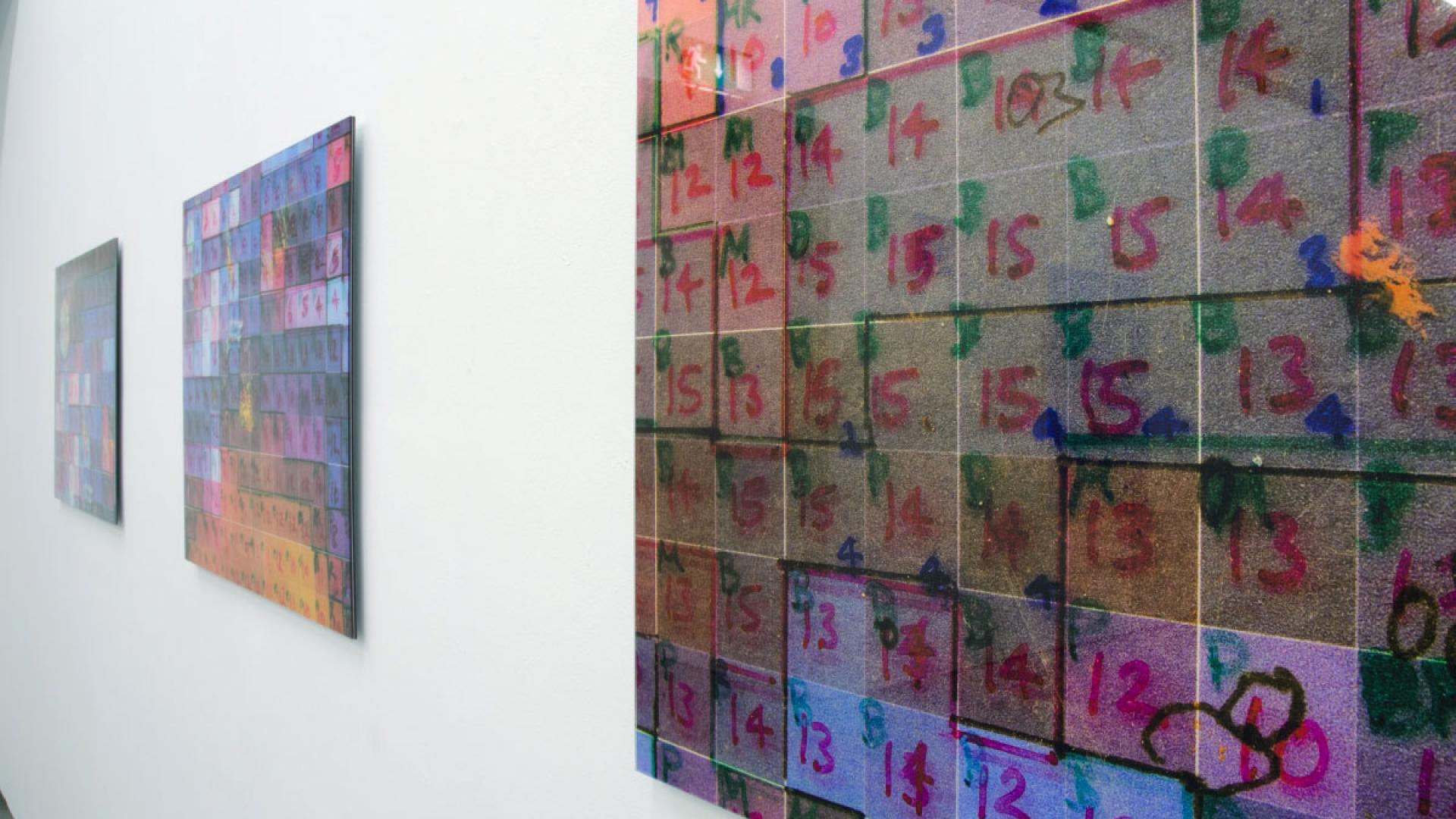
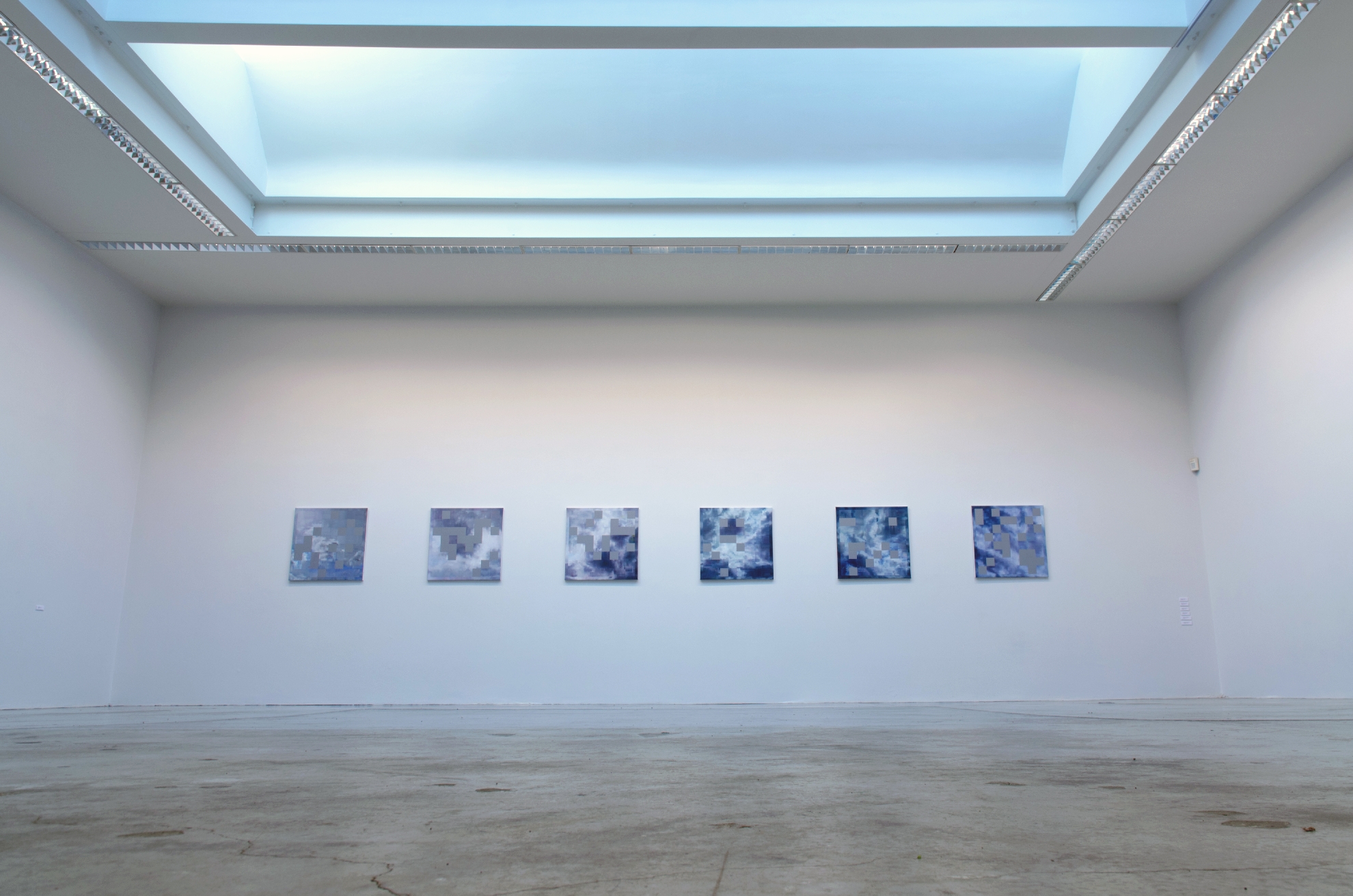
This tension between controlled and free expression is also an interesting way to approach Enda O’Donoghue’s paintings with its fluctuation between methodical analysis and randomness as operative principles. The series of medium to large canvases that compose the LCGA exhibition ‘The Last Days of Gravity’ are all recent works by the artist. For the last seven years he has been painting from digital photographs culled from the internet. Sifting through the huge depository of disposable shots, O’Donoghue looks for traces of a transient moment that the digital age has multiplied exponentially. Their ultimate disposability is then transposed to the slow and painstaking process of the ‘noble’ medium of oil paint into a glorious display of vibrant colours.
The four-year span of the paintings on display shows a small but significant shift in subject matter and representation. The 2009 and 2010 paintings of the North Gallery are based on people’s casual self-representation, with the titles taken from their own accompanying comments, creating another layer of reflexivity: Too slutty?, Wow, my stomach looks great! – As a matter of principle, the artist always contacts the photographers for permission to use their work, for copyright issues but also to break the anonymity of the internet.[4] In the South Gallery, with works from 2012, light and ambiance have become the subject matter of choice such as the overlapping of natural and artificial lights of a fair ground at dusk in even prettier once it got dark or Octopus.
Although keeping the strict grid-like structure mirroring the pixellated image-source, a change in painting technique is also visible. In the earlier paintings, the artist uses regular brushstrokes alternatively vertical and horizontal whose repetition is emphasised by the application of a stamped checkered pattern over the surface of the painting: accenting a methodical approach. A displayed sign of evolving technique can be seen in the juxtaposition of Too Slutty with Uncropped, the latter being a strip from the same source image as the former but painted two years later. It shows the abandonment of the stamped pattern and a mellower approach to blending colours and form, blurring them together. It also introduces an occasionally loose brushstroke. O’Donoghue speaks of inviting errors, misalignments and glitches which can be easily associated with digital noise or files’ corruption, but can also be applied to these sudden interruptions in the pattern by a slip of the brush or a swirl of paint. The later paintings, and most strikingly the Deep Blue series and Ellipsis, evade the formula in introducing pixels devoid of information and painted a uniform grey or black next to squares that verge on impressionism: and the Deep Blue series has something of Claude Monet’s series of Cathedrals or haystacks.
Although based in Berlin, O’Donoghue has kept a strong connection with Limerick, regularly exhibiting there as well as visiting Limerick School of Art and Design’s students. Berlin, since its strangely stranded situation as a western island into DDR territory prior to the fall, has been a magnet for artists and has well honed skills in using slack spaces for artistic purposes – an ability that the rebooted city is tapping into, branding its poverty as sexy. In spite of a dire economic situation Berlin has fostered an incredibly vibrant art scene that rivals richer cities. There are some parallels with Limerick, here. Limerick has been badly hit by the economic slump and has reacted in placing its trust in its artists. Creative Limerick, initiated by Limerick City Council, has helped form a network of artist-led spaces and organisations such as Occupy Space, Ormston House or Faber Studios that have made Limerick, Ireland city of culture well before 2014.
Michaële Cutaya 2013
Published by the Limerick City Gallery of Art
[1] Helen Carey ‘Curator’s Choice’ in The Irish Times, A Special Report, Into the Light, Monday 26 November, 2012, p. 25
[2] Brian O’Doherty, ‘The Irish Imagination’ in Source in Irish Art, A Reader, edited by Fintan Cullen, Cork University Press, 2000, p. 268.
[3] Into The Light, the Arts Council – 60 Years of Supporting the Arts, Limerick, Text compiled and written by Cliodhna Shaffrey, Sabina MacMahon and Emma Dwyer, Nival 2012.
[4] Interview in Occupy Paper issue 4 by Susan Holland pp. 20-25 October 2010.


